Rookie Tryouts

Eight drills.
Then you talk ball.

Pick any drill, in any order. Every question is freshly shuffled, so you'll never be asked anything twice in a sitting. Where a drill mentions a word, you can watch it happen.

Choose your drill

Drill · 4 min

The floor is a map

Five lines and you'll never be lost in a game again.

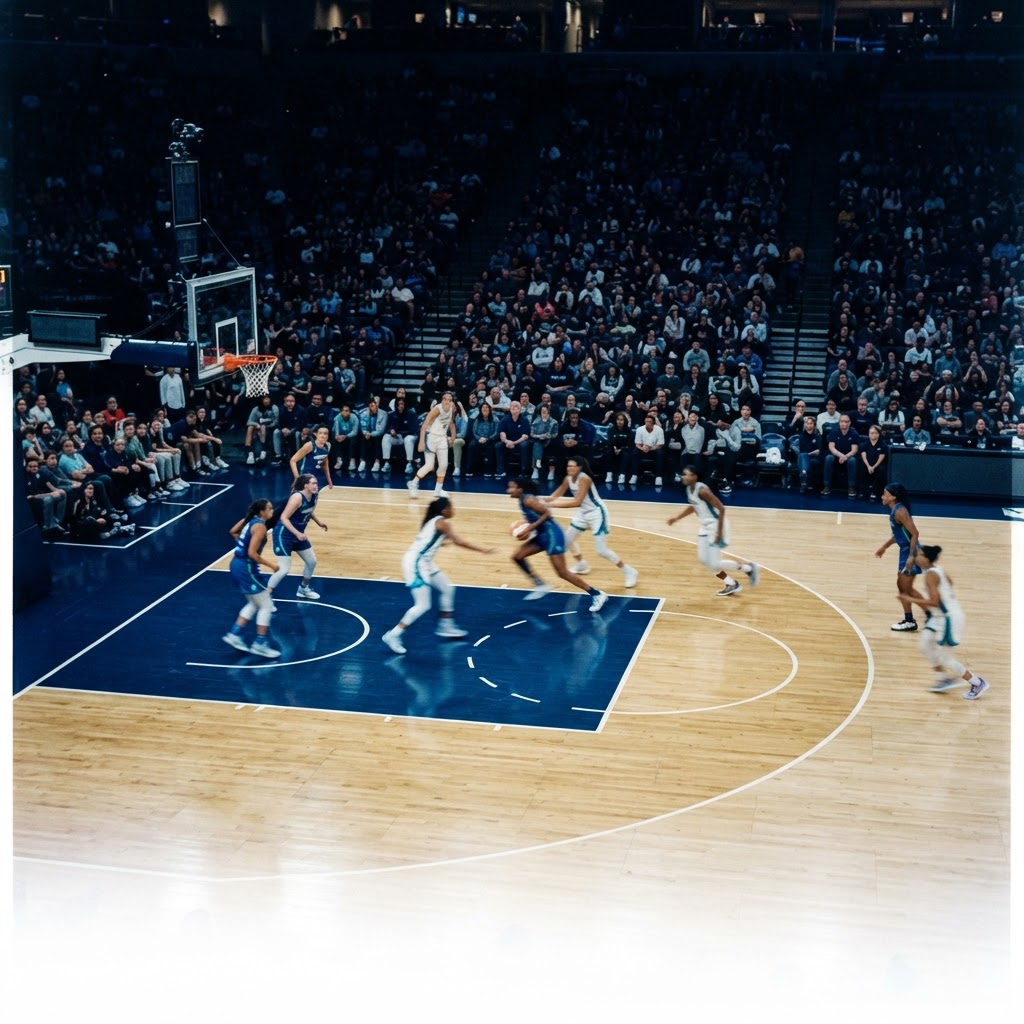
Picture a basketball court like a neighbourhood. The paint is the busy block right under the hoop, the arc is the city limit out past it, and the baseline is the edge of the map where you can't step.

Everything else is space. Winning teams aren't hiding plays — they're finding room. When a team 'spaces the floor', they're literally spreading out so the defense has to cover more ground than it can.

Lingo, translated

  • The paint: The rectangle under the hoop. Standing there for 3 seconds on offense is a violation.
  • The arc: The curved line (23'9" in the WNBA). Behind it, a bucket is worth 3.
  • Baseline: The line behind the hoop. Step on it with the ball and you're out.

Ball talk

14 terms · tap to open

  • BucketScoring

    A made basket. Two points if it went in from inside the big curved line, three if it went in from behind it. Fans also call a player a 'bucket' when she scores easily.

    Example: She catches a pass, takes one dribble and shoots. The ball drops through the net. That is a bucket, and the scoreboard adds two.

    Watch it in action
  • Bucket GetterScoring

    The player a team gives the ball to when it has to score, usually in the last minute of a close game.

    Example: Down two with twelve seconds left, the coach calls timeout and draws up a play for one person. Everyone in the gym, including the other team, knows who is taking that shot.

    Watch it in action
  • Pick & RollOffense

    Two teammates working together. One stands still in the path of a defender and does not move; that standing block is the pick. Her teammate dribbles around it, then the player who set the block turns and runs to the hoop. The two defenders cannot cover both, so somebody ends up open.

    Example: The guard dribbles left, her teammate steps into the guard's defender, the tall defender has to slide across to help, and the teammate runs alone to the hoop for an easy catch and layup.

    Watch it in action
  • IsoOffense

    Short for isolation. The other four players go stand at the edges of the court so one scorer can attack one defender with the whole middle of the floor empty.

    Example: Fourth quarter, the star waves everyone to the corners and dribbles at her defender one-on-one while the other eight players stand still and watch.

    Watch it in action
  • And-OneScoring

    A shot made while someone fouls you. The basket still counts, and you get one extra shot from the free-throw line with nobody guarding you. That single shot is the 'one'.

    Example: She drives into traffic, takes the hit, and the ball rolls in anyway as the whistle blows. She walks to the free-throw line with a chance to turn two points into three.

    Watch it in action
  • Box OutRebounding

    Claiming the space right next to the hoop the moment a shot goes up, with your body between your opponent and the ball, so she cannot step in front of you to grab the miss. It is not jumping, it is getting there first.

    Example: The shot goes up, the defender turns and plants her back into her opponent's legs. When the ball comes down, it lands in the space she just claimed.

    Watch it in action
  • TransitionOffense

    The first few seconds after a team wins the ball, before the other team is back in position to stop them. Scoring then is the easiest scoring in the game.

    Example: A steal at midcourt, two quick passes, a layup. The whole thing takes four seconds, while the other team is still jogging back up the floor.

    Watch it in action
  • ScreenOffense

    Standing completely still in the way of a defender so a teammate can run past and get free. Same idea as a pick. Move while you are doing it and it is a foul.

    Example: The wing jogs up, stops shoulder to shoulder with the defender, and the ball-handler dribbles past her hip with nobody in front of her.

    Watch it in action
  • ReboundRebounding

    Grabbing the ball after a shot misses. The team that grabs more misses usually gets more shots, so a great rebounder can decide a game while barely scoring.

    Example: The three-pointer bangs off the back rim. Both tall players jump, and the one who claimed her space first comes down with the ball and a fresh shot clock.

    Watch it in action
  • TurnoverDefense

    Losing the ball before your team gets a shot away. A pass that goes to nobody, too many steps, or the ball taken away by an opponent. The other team gets it straight away.

    Example: The pass sails over her teammate's head and out of bounds. The referee hands the ball to the other team, and the chance is gone.

    Watch it in action
  • Triple-DoubleStats

    Ten or more in three different categories in the same game, usually points, rebounds and assists. It means one player changed the game in three separate ways.

    Example: By the final buzzer she has 14 points, 11 rebounds and 10 assists. The announcer reads out the triple-double and the building stands up.

    Watch it in action
  • PPG · RPG · APGStats

    Per-game averages, not season totals. PPG is points per game, RPG is rebounds per game, APG is assists per game. They let you compare players who have played a different number of games.

    Example: A player averaging 17.4 PPG scores about seventeen points every time she plays, not seventeen points all season.

    Watch it in action
  • 6th WomanLeague

    An award for the best player who begins the game on the bench. She is not one of the five starters, but she plays nearly as many minutes and often changes the game the moment she checks in.

    Example: The winner enters at the six-minute mark of every quarter, and her team's energy lifts the moment she steps on the floor.

    Watch it in action
  • Call-UpLeague

    When a bigger league signs a player out of a league like UPSHOT. The player leaves mid-season for the bigger stage, which is the pathway the whole league is built to create.

    Example: Shyanne Sellers played for the Waves, then the Los Angeles Sparks signed her for their season. That was the Waves' first WNBA call-up.

    Watch it in action

League primer

Your courtside league guide

Pick a league to learn the rules, meet the teams, and explore rosters, schedules, and official shops.

Unrivaled

3x3 · 8 clubs

Eight clubs, three a side, on a compressed full court — a winter league built around speed.

What the rulebook says

  • 3-on-3, full court

    A 72-by-49.2-foot court instead of the usual 94-by-50, so the floor is never crowded.

  • 18-second shot clock

    Six seconds shorter than the WNBA's, so every possession has to move.

  • No clock in the fourth

    The leader's score after three seven-minute periods, plus 11, becomes the winning score.

  • One free throw

    Fouls send you to the line for a single shot, worth 2 or 3 depending on the attempt.

How it differs

The shortest season of the four, played January to March, with eight clubs and a touring schedule.

The draft class

How a WNBA draft pick actually happens

A pick is a contract slot, a roster bet and a trade chip all at once. Here is the whole path, from becoming eligible to surviving the last cut.

  1. 01

    Get eligible

    There are two doors in: finish your college eligibility (or graduate in the draft year), or meet the league's age floor. Players coming from outside the U.S. have a separate age rule.

    The exact numbers live in the CBA and are re-checked every year — the league site is the source of truth.

  2. 02

    The lottery sets the order

    Teams that missed the playoffs go into a weighted lottery. The rougher the season, the better the chance at the top pick. Everyone else lines up behind them by record.

    Picks get traded, so the team on the clock is often not the team that earned the slot.

  3. 03

    Round after round

    Teams pick in order, then the order runs again for the next round. A pick is a cheap, cost-controlled player — which is why contenders trade for picks years before they use them.

    Picks can be protected or swapped. Read the conditions, not just the round number.

  4. 04

    The rookie contract

    Drafted players sign a rookie-scale deal set by the CBA. It costs the team far less than a veteran contract, and that gap is the real value of a high pick.

    Length, guarantees and team options come from the CBA — not from the team that drafts you.

  5. 05

    Make the roster

    Being drafted is an invitation, not minutes. Undrafted players still get camp invites and short-term deals, and rosters get trimmed before opening night.

    Plenty of rotation players in this league were never drafted at all.

Words you'll hear on draft night

Lottery oddsFirst-round pickProtected pickPick swapRookie scaleUndrafted free agentCamp inviteCap space

Dates, order and the current round structure change with each CBA. For this year's numbers, read the league's own draft page.WNBA.com

Next stop

Turn drills into a career

After the Buzzer is where the studying turns into a portfolio, an internship or a first job in sports.

Open After the Buzzer
OTSON THE SIDELINESCO.

A fan house for women finding their power in basketball — the lifelong fans, the brand-new ones, and everyone building a career behind the game.

For the bold city dreamers

The house

Unofficial fan project. On the Sidelines Co. is built with Base44 AI for a professional portfolio and community engagement. It is not affiliated with, endorsed by, or sponsored by the UPSHOT League, the WNBA, Unrivaled, any team or any player, and it generates no revenue. All names, logos, marks, photos and footage belong to their owners and appear here only as linking references — write to us for removal. Stats and storylines link to official league and team newsrooms. Money and audience figures are dated public snapshots, not live market data. Win probabilities are an educational model, not betting odds — never wager on them.

No profits, no ads, no data selling. Analytics only if you opt in.

Your call on analytics

This is a student project, and the counts are how the fan house reports on itself: whether it is reaching new women's basketball fans, how it's growing, and where it needs work.

What's used, plainly: Base44's built-in analytics events plus a first-party visit count kept in this browser. No Google or Meta pixels, no ad networks, no selling data, and nothing that identifies you.